New session creation workflow
In this update, the main goal was to reinforce Sessionbound new positioning: less “feature collection,” more operating system for campaign continuity.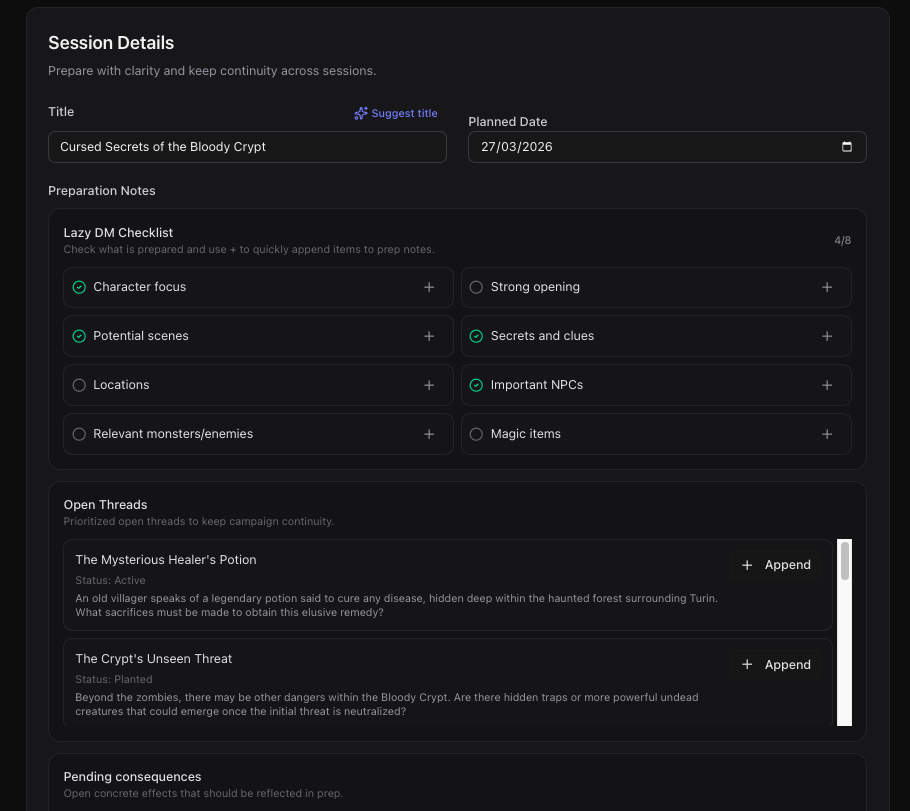
Key updates:
- Structured session flow: the session hub is now explicitly organized into Pre-Session, During Session, and Post-Session, each with clear intent.
- Stronger During Session workflow: GMs can now log Codex entries, Threads, and Consequences in one place while play is happening.
- Session-bound note: we added a dedicated rich-text note tied to each session, so GM context stays attached to that session instead of getting lost in generic notes.
- Consequences as a first-class domain: consequences are no longer only session-local; they now have a dedicated campaign-level hub with create/edit/track workflows.
- Copilot and prompts aligned: terminology was standardized from “hooks” to “threads,” and contextusage was improved for more continuity-aware outputs.
Lazy DM as the core:
- The Lazy DM checklist is now the operational backbone of prep.
- “Generate Plan” no longer outputs generic buckets; it now maps directly to Lazy DM structure:
- Character focus
- Strong opening
- Potential scenes
- Secrets and clues
- Locations
- Important NPCs
- Relevant monsters/enemies
- Magic items
- This removes friction between AI suggestions and real GM prep behavior.
- Practical result: less reformatting, more predictable prep, stronger continuity between sessions.
- Open consequences are now treated as real planning constraints, helping convert narrative impact into concrete next-session actions.
Outcome:
- Sessionbound is now more aligned with real campaign workflows.
- Lazy DM is no longer just a UI checklist; it now drives assisted planning logic.
- Campaign memory is significantly more reliable through Threads + Consequences + session-bound notes.
Leave a comment
Log in with itch.io to leave a comment.